Field Identification: Horsemint (Monarda punctata)
This page provides a field-oriented identification overview for horsemint (Monarda punctata). The emphasis is on visible traits and common points of confusion. It is intended to help readers recognize the plant in the field without relying on aroma alone.
Identification should be based on morphology first. Aroma can support an ID, but it should not be treated as proof of species.
Habitat and where it tends to appear
Horsemint is commonly found in open, sunny areas with relatively low competition. It is often associated with sandy or well-drained soils and is frequently seen in disturbed settings such as roadsides, field edges, open pastures, and prairie-like clearings. In many regions it appears as scattered plants or small patches rather than dense monocultures.
Habitat alone is not diagnostic, but it provides useful context. If a plant matches the structural description below and is growing in a hot, open, well-drained setting, the probability of a correct identification increases.
Overall growth form
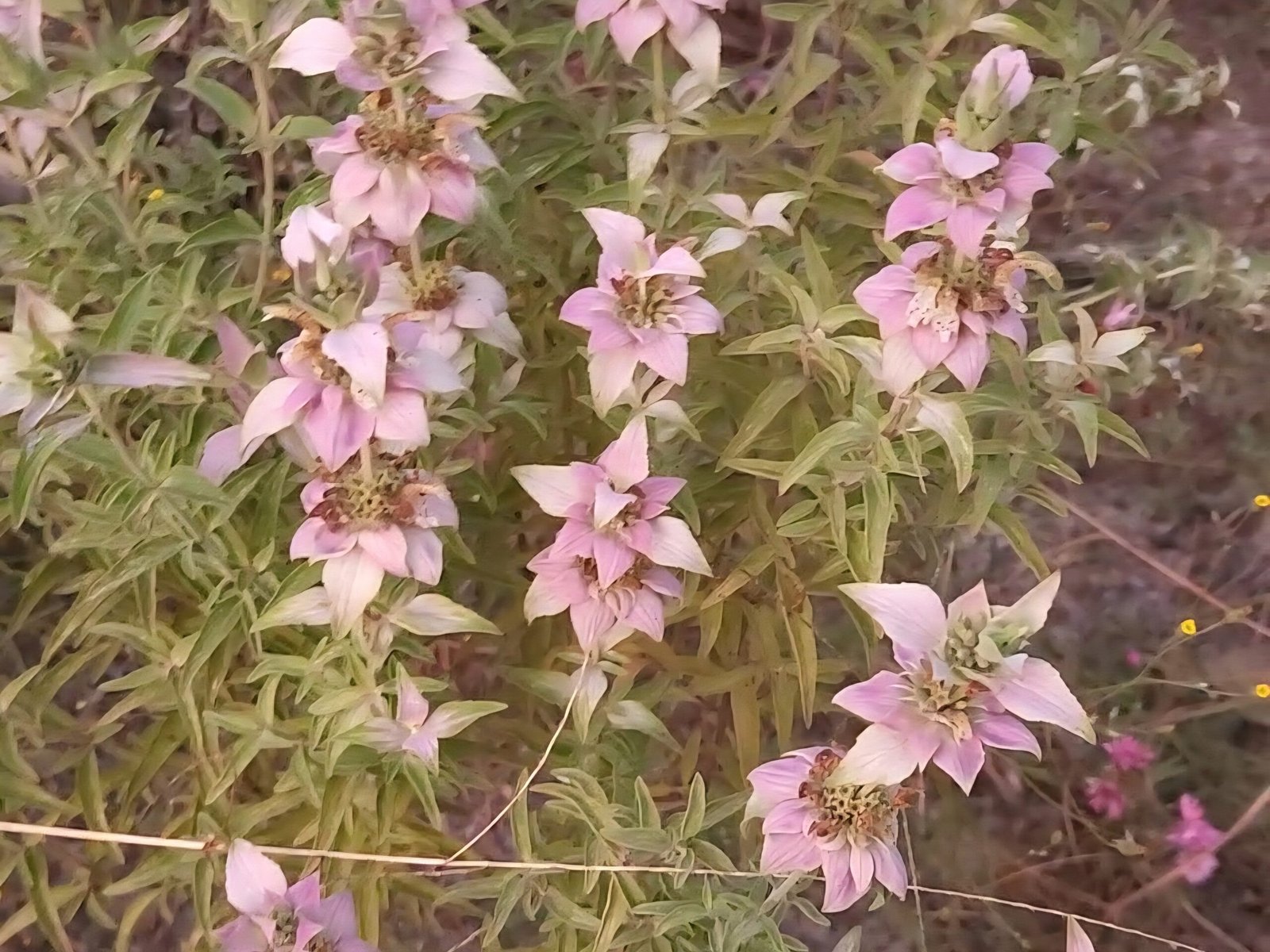
Monarda punctata is an upright herbaceous plant that typically presents as a single stem or a few stems from a base. Like many members of the mint family (Lamiaceae), it has a squared stem and opposite leaf arrangement. The plant’s most visually distinctive feature is its flowering structure: tiered bracts stacked along the upper portion of the stem.
If the plant is in bloom, those stacked bract “tiers” are often the quickest field-level cue that you are looking at horsemint rather than a more uniformly flowered bee balm.
Leaves
Leaves are opposite (paired across the stem) and generally lance-shaped to ovate-lanceolate. Leaf edges are often slightly toothed. Leaves can vary in size and texture depending on local conditions, so leaf traits are best used as supporting evidence rather than a single deciding feature.
In field identification, leaves help confirm that you are dealing with a mint-family plant, but the flowering region and bract structure are typically more diagnostic for horsemint.
Stem
The stem is characteristically square in cross-section, a common trait of the mint family. Depending on the plant’s age and conditions, the stem may be relatively smooth or slightly hairy. The square stem trait supports placement in Lamiaceae, but many aromatic plants share it, so it should be treated as confirmatory rather than unique.
Flowering structure: the key field marker
Horsemint’s most useful identification feature is the arrangement of bracts and flowers in stacked tiers along the upper portion of the plant. Rather than forming a single tight head at the very top, horsemint typically forms multiple whorls separated vertically, creating a layered appearance.
The bracts are often pale, sometimes with pink or purple tones, and may show spotting or coloration that contributes to the “punctata” impression in some descriptions. Flowers emerge within these bract tiers. When in bloom, the plant can look architectural—almost like a stacked set of collars around the stem.
If you remember one cue, remember this: stacked bract tiers along the stem are strongly suggestive of Monarda punctata.
Aroma: useful, but not proof
Horsemint can be strongly aromatic. Some populations produce an aroma that people describe as oregano-like or thyme-like. This overlap is part of why the plant is often chemically compared to other aromatic herbs. However, scent varies by chemotype and growing conditions, and many unrelated plants can share similar aromatic notes.
Aroma should be treated as supporting evidence only. If the plant’s morphology does not fit, aroma alone should not override that mismatch.
For chemotype context, see: Species & Chemotypes and Thymol & Carvacrol in Horsemint.
Common look-alikes
The most frequent confusion occurs within the Monarda genus and with other mint-family plants that share square stems, opposite leaves, and aromatic foliage.
Other bee balm / wild bergamot types: Some Monarda species are commonly called “bee balm” or “wild bergamot” and may share general appearance at a distance. Many of these species form more consolidated flower heads or have a different bract arrangement than horsemint’s tiered structure.
Other mint-family herbs: Plants like oregano and thyme differ strongly in growth habit and leaf form, but scent similarity can still mislead people. Horsemint is a North American wild plant with its own structural pattern; it should not be assumed to be a culinary herb substitute based on aroma.
For comparison-based clarification, see: Comparisons.
A conservative field checklist
A cautious identification of Monarda punctata typically requires multiple features aligning at once. In the field, the strongest combination is:
• Mint-family structure (square stem, opposite leaves)
• Upright growth form in open, sunny habitat
• Distinct stacked bract tiers along the upper stem during flowering
• Aromatic foliage (supporting cue, not decisive)
If the tiered bract structure is absent and the plant instead forms a single consolidated head or a different arrangement, the identification should be treated as uncertain until confirmed by a botanical key or reference.
Where this fits in the library
This page supports the identification section and should be read alongside:
• Naming & Classification
• Species & Chemotypes
• Historical Overview of Horsemint
• Comparisons
Citations
This identification overview is based on standard botanical traits used for mint-family plants and Monarda species. For authoritative taxonomy and distribution references, use reputable botanical databases. Links open in a new tab.
• USDA PLANTS Database
• Lady Bird Johnson Wildflower Center: Native Plant Database
• GBIF: Global Biodiversity Information Facility
This content is provided for educational and informational purposes only. It does not constitute medical advice, diagnosis, or treatment.